

History Cycles
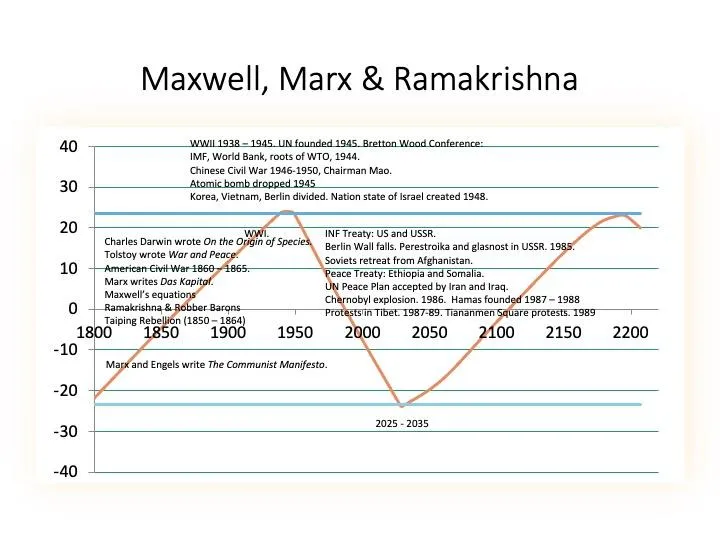
14: Cycle of Marx, Maxwell & Ramakrishna
History Cycles
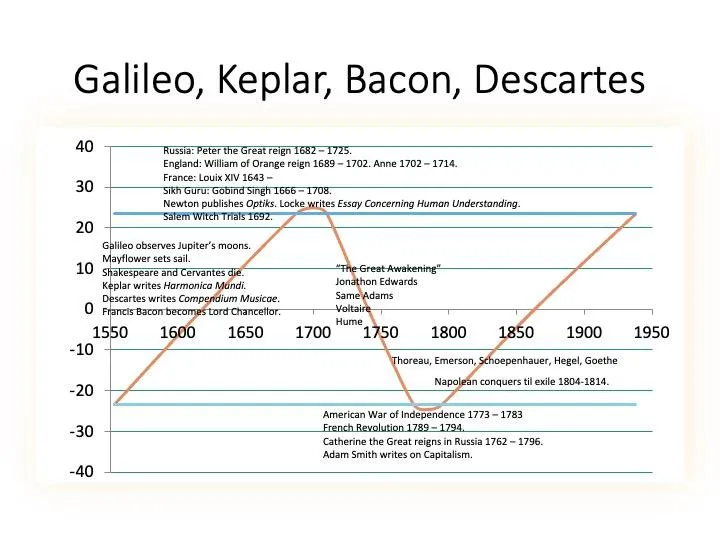
13: Cycle of Galileo, Kepler & Descartes
History Cycles
12 Part 3: Cycle of Ivans and the Ming Dynasty
History Cycles
12 Part 2: Cycle of Henri II of Castile
History Cycles
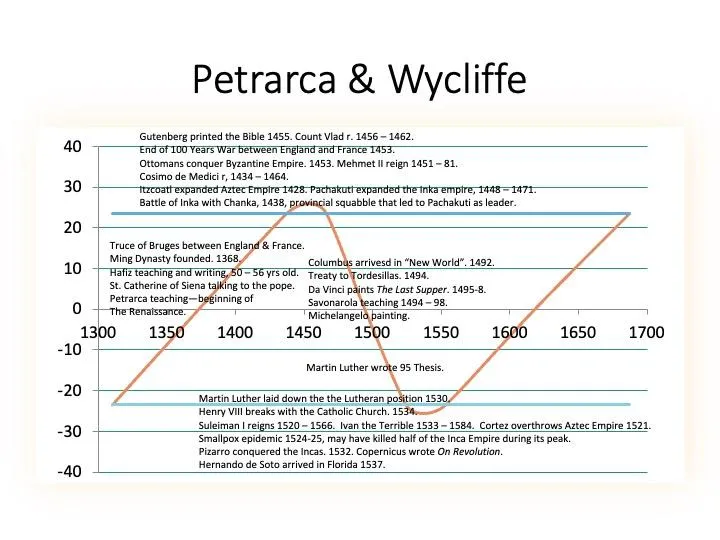
12 Part 1: Cycle of Petrarch & Wycliffe
History Cycles
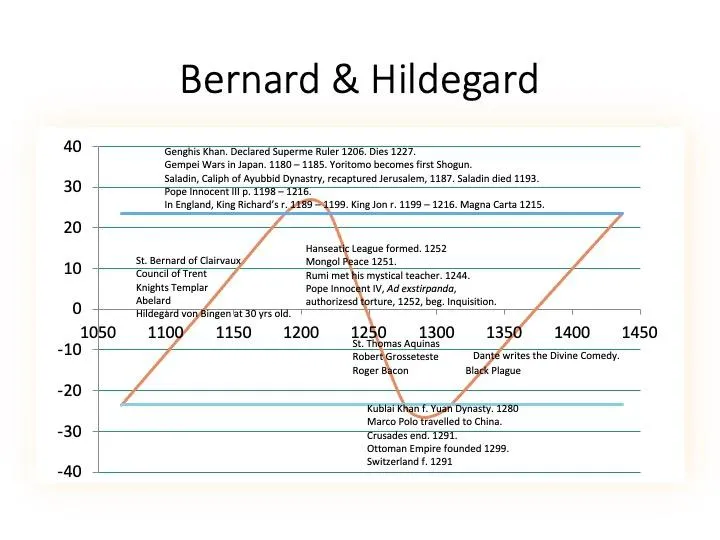
11: Cycle of Bernard of Clairvaux
History Cycles
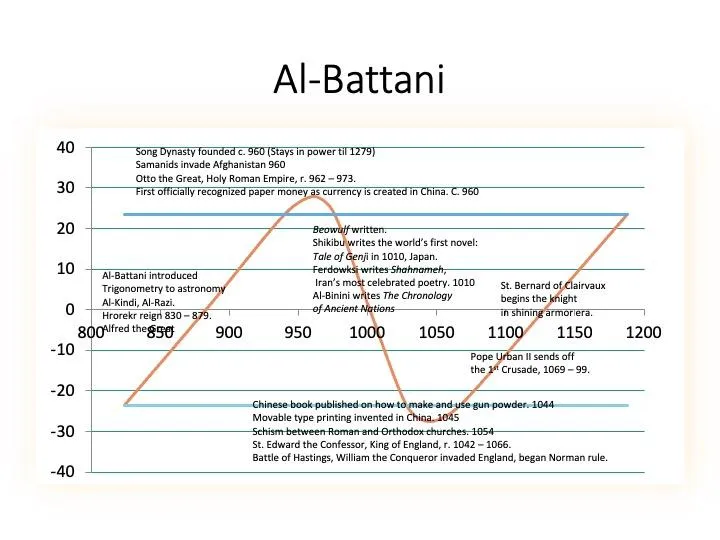
10: Cycle of al-Battani
History Cycles
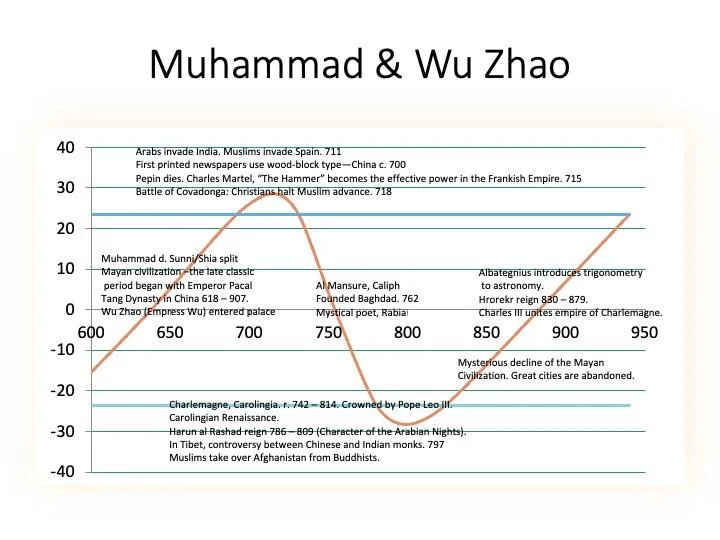
9: Cycle of Muhammad
History Cycles
8: Cycle of Augustine
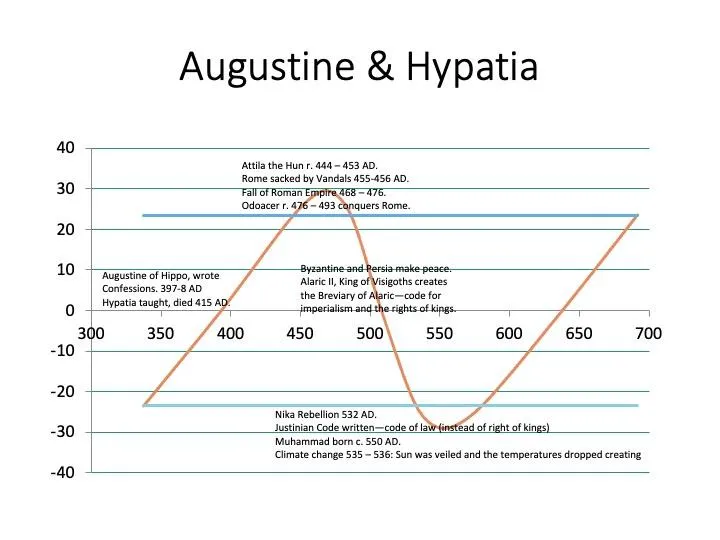
The significan visionaries for this cycle are Augustine and Hypatia. I focus on Augustine because at the beginning of this cycle Theodosius, the Roman Emperor, has just eliminated freedom of religion transitioning the empire to only Christianity, killing many pagans and destroying the libraries and temples of the Greeks and Romans. Augustine represents the new--the new Christian doctrines that embolden the Byzantine Empire that takes shape while the Roman Empire falls. Hypatia represents what is falling and in decline in this cycle.
The Huns and the Goths and the Vandals successfully invade the Roman Empire during the Power time, establishing a new Christian gothic empire, the Byzantine Empire. During the Reform time, chaos and unrest seems to be leading the Byzantines into decline and a quick fall, but Justinian and his new laws change the tide into greater support for the people, and in turn supports three more Pluto cycles of Byzantine Empire life.
History Cycles
7: Cycle of Ptolemy
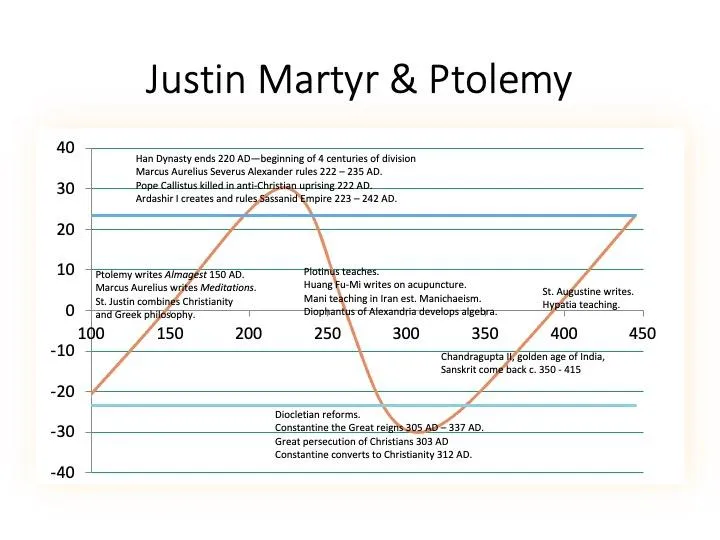
This cycle begins with an astrologer, or should I say the astrologer, Ptolemy. During the Vision time he wrote a text book that became "the textbook" on astronomy and astrology. I focus a bit more on Justin because Justin's visionary work during Vision leads directly to an extraordinary change during the Reform time. This is a cycle where it was definitely very dark just before everything changed very dramatically in the Roman Empire when Pluto was at the peak of OOB South.
History Cycles
6: Cycle of Cicero
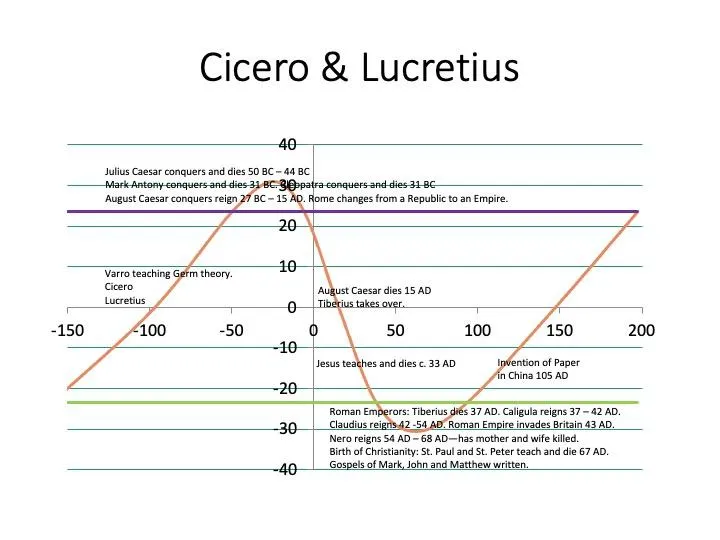
Ahhh . . . the Roman Empire from Cicero (Vision) to Augustus (Power) to Tiberius (Justice) to Caligula to Claudius to Nero (Reform) . . . . to a year of 4 emperors precisely during Reform. This cycle full of emperors we have know and fear. Perfectly aligned with the Pluto cycle, the Roman Empire rises and finds a way through Pluto OOB South in its own unique way. Find out where Jesus, Boudica, and Paul fall into this cycle.
History Cycles
5: Cycle of Aristotle
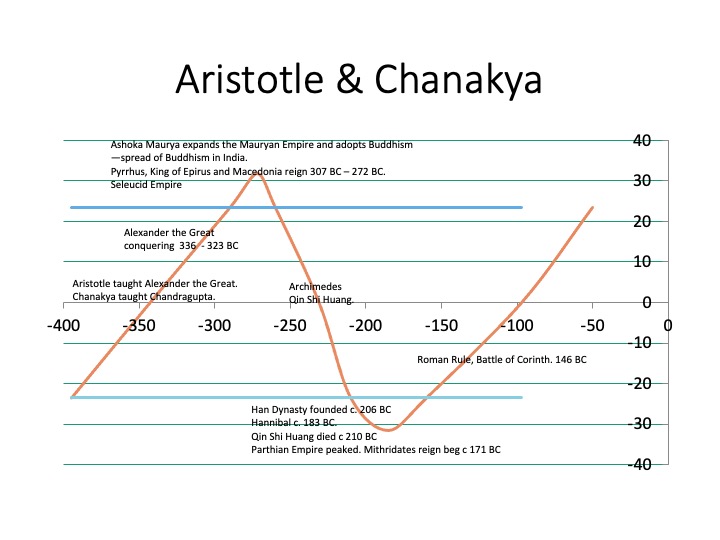
At the beginning of this cycle, in 343 BCE, Aristotle was in his 40s with his own school and Philip II of Macedon had amassed a well-trained army. Alexander was Philip's hyperactive (I'm guessing) son. Philip hired the very best tutor in the world to teach his son. I can only imagine that Aristotle had his reasons for taking the job, but he probably wasn't too excited about teaching a teenager. Anyway, he did teach him and Alexander did learn and did go own to conquer more land than any other conqueror in history til that time. Alexander died before Aristotle, and left behind not just one empire, but three. By the time the Reform time arrived the Carthaginian rebel, Hannibal, was leading a rebel army over the Alps.
History Cycles
4: Cycle of Thales
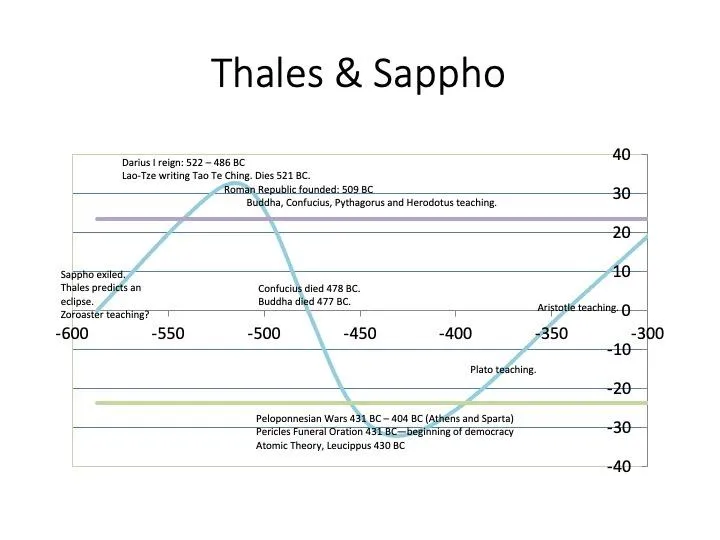
This cycle begins with an extraordinary conjunction of planets. While Pluto was at the Vision point, it was also conjunct Neptune and Uranus. That triple conjunct has not happened since and won't happen again until 3370 AD. This rare conjunction is considered the beginning of the Axial Age and corresponds with the year that Thales accurately predicted an eclipse using science and math. Thales is considered the father of science. His works launched a new era, during the same time that Zoroastrianism was launching a new age of spirituality.
During this cyle, Buddha, Confucius, Lao Tze, Sun Tzu, Socrates, and Plato, all walked this earth (if they were actually embodied or not). It is the time of rise and fall of the Ancient Greeks. The peak of Pluto OOB South is 431 BCE, the year that Athens lost a significant battle to Sparta, and Pericles gave his great Funeral Oration. In this Reform time, the Greek city states starting fighting each other--an implosion that ultimately ended the great time of Athens. Yet, the philosophies that arose during this cycle have stood the test of time.
History Cycles
3: Cycle of Lycurgus
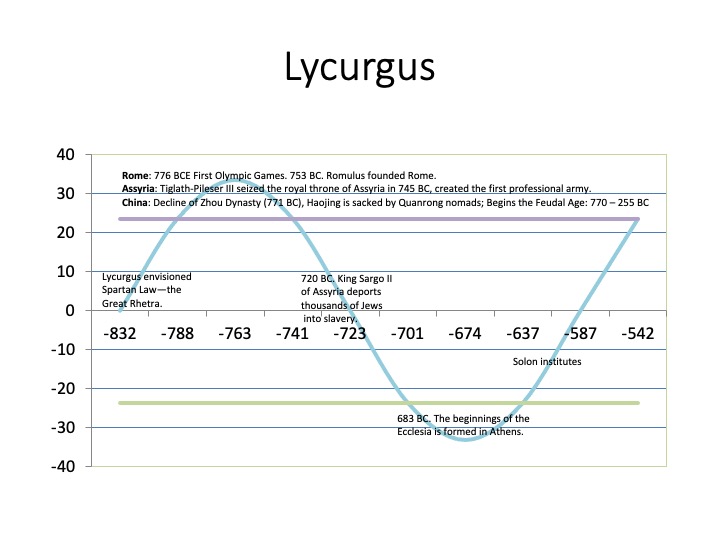
This cycle begins with a mythical (perhaps real) person who visited an oracle and returned with a fully formed vision for a new society--one based on a strong military, discipline and community support. That society became the Greek land of Sparta. In a city-state nearby, other mystery-mythical people were envisioning a society based on knowledge and creativity. That society became the Greek land of Athens, where gods and goddesses oversaw the ways of humans, and great philosophers hung out on marble steps under large columns wearing togas, saying very wise things. Actually, this is the cycle before the really cool time of Athens . . . that's the next cycle. But this cycle gets us ready by introducing the Ecclesia--an early form of a partial democracy.
The Empire that fits this cycle best is the rise and fall of Assyria--not the first or second Assyrias--but like the third or fourth, maybe fifth, version of Assyria. As Syria today reconfigures itself, it is helpful to remember just how many times Syria (Assyria) has recreated itself. ( I don't know how many times . . . but it is a lot.)
History Cycles
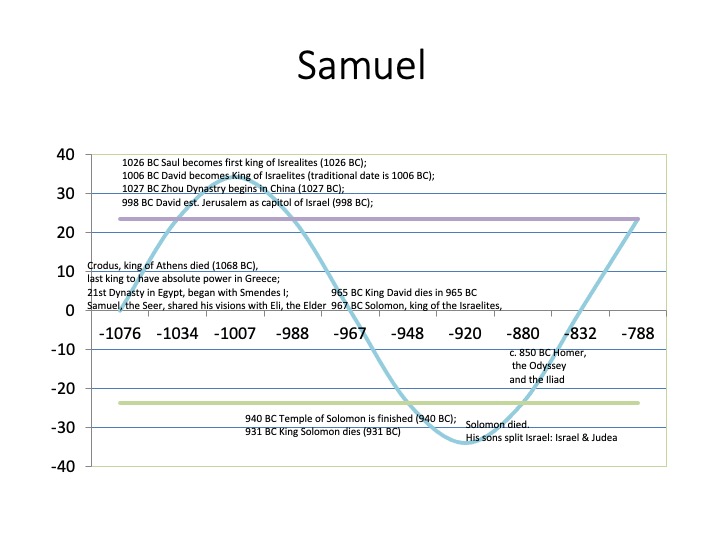
2: Cycle of Samuel
This cycle begins with a well known prophet, Samuel, in the Bible. His vision during the Vision time supports the creation of the nation state of Judea, that rises and falls during this cycle. This cycle mirrors in many ways the rise (and perhaps fall) of the nation state of Israel. The fall of Judea took place after the death of Solomon during the Reform stage. Solomon's sons split the kingdom in two, and ultimately led to its decline.
History Cycles
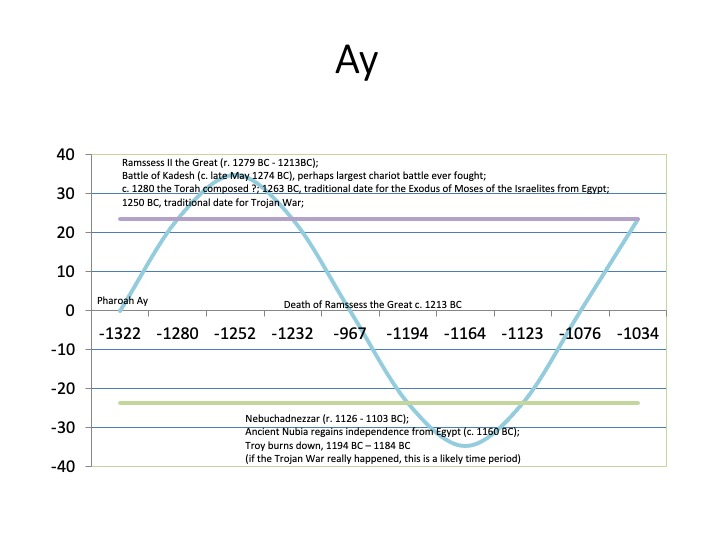
1: Cycle of Ay
We begin our series of Pluto cycle talks with the visionary Ay, leading into a Power time that includes Ramses the Great and the Battle of Qadesh, when the great Egyptian and Hittite armies fought for dominance. Instead of a clear winner, the boundary line between the empire did not move, even if both sides declared themselves victors. At Justice both the leaders of the Egyptians and the Hittites died, and the empires started to move into decline, but nothing prepared them for the extraordinary shift that happened at Reform during the time commonly referred to as the Bronze Age Collapse.

Persephone's Revolution Podcast and Talks
Astrologer Rosie Finn and her historian brother, Ray Finn, talk about the planetary cycle of Pluto in declination throughout history, taking apart current events, and projecting potential outcomes for the future--all pointing to an upcoming revolution, reformation, collapse, and ultimately the end of empire as we know it.
Support the Podcast
Rosie Finn
[email protected]
View our Privacy Policy and Terms and Conditions here. © 2026. All Rights Reserved.